
How to Identify a Watch From a Photo
Got a photo of a watch and no idea what it is? Here are 5 ways to identify any watch from a picture, plus how to check what it's worth.
The fastest way to identify a watch from a photo is to run it through an AI watch identifier app, then confirm the result against the watch’s reference number. If you only have a screenshot, a reverse image search or a watch forum can fill the gaps. This guide walks through all five methods, how to take a photo that actually gets a match, and how to find out what the watch is worth once you know what it is.
First: take a photo that can be identified
Most failed identifications come down to the photo, not the tool. A watch that looks obvious to you can be ambiguous to software (and to people) because many models share the same case or dial layout and differ only in small details.
Before you try any method below, get the best shot you can:
- Shoot the dial straight-on. Hold the camera parallel to the crystal. Angled shots distort the dial and hide the text.
- Kill the glare. Tilt the watch slightly away from overhead lights or a window until the reflection on the crystal disappears.
- Fill the frame. The dial should take up most of the image. Avoid zooming digitally, move closer instead.
- Make the text readable. The brand logo, model name and any small print on the dial (e.g. “Superlative Chronometer”, “Automatic”, “200m”) are the strongest clues.
- Take a second photo of the caseback, and if you can, the clasp. That’s where reference numbers, serial numbers and calibre numbers usually live.
If you’re working from someone else’s photo (a listing, a film still, a picture on social media), crop it tightly around the watch before you search.
Method 1: Use an AI watch identifier app
A dedicated watch identifier app is the quickest route from photo to answer. Instead of matching pixels the way a general image search does, it looks at the details that separate one model from another, like bezel style, hands, indices, date window, case shape and bracelet, and returns a specific brand, model and likely reference number.
Here’s what a result looks like in Watch Identifier & Value for a two-tone Rolex Submariner with a blue dial:
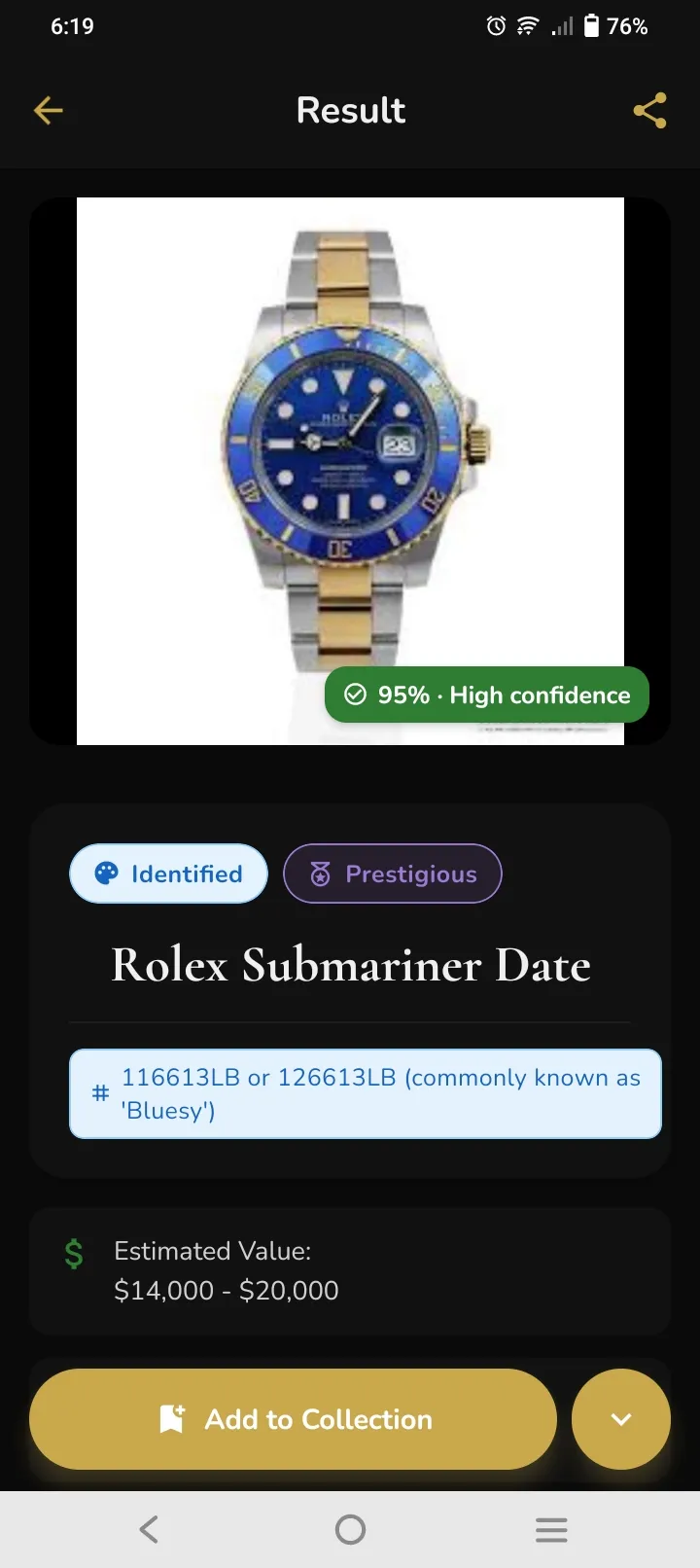
A few things worth noticing:
- It names the model, not just the brand. “Rolex Submariner Date” rather than “Rolex diver.”
- It gives reference number candidates. The two-tone blue Submariner was made in two closely related generations (116613LB and the newer 126613LB, nicknamed the “Bluesy”). From the front, they’re almost identical, so a good identifier tells you both and lets you confirm.
- It shows a confidence score. High confidence means the visual match is strong. Lower confidence is your cue to double-check with one of the methods below.
- It estimates value. You get a market price range alongside the identification, so “what is it?” and “what’s it worth?” are answered in one step.
This is the method to start with when you have the watch in hand or a clear photo of it.
Method 2: Reverse image search (Google Lens)
Google Lens, along with other reverse image search tools, finds images on the web that look like yours. It’s free, built into most Android phones and the Google app, and handy when your only source is a screenshot.
Where it works well:
- Popular, widely photographed models (a Rolex Datejust, an Omega Speedmaster, a Casio G-Shock).
- Finding the original listing or article a photo came from.
Where it struggles:
- Lookalike models. Lens matches visual similarity, so it can’t reliably tell a 116610 Submariner from a 126610, or a Seiko from a homage watch that copies its design.
- Busy or cropped photos. A watch on a wrist in a film still often returns results for the jacket or the person instead.
- Vintage and obscure watches with few photos online.
Treat Lens results as leads. Open the top matches and compare details (bezel markings, crown guards, hands, date position) against your photo before you trust the answer.
Method 3: Ask a watch community
Watch enthusiasts are remarkably good at this, especially with vintage pieces. Communities such as r/Watches on Reddit and forums like WatchUSeek regularly help people identify watches from photos.
To get a useful answer quickly:
- Post the clearest dial photo you have, plus caseback and movement photos if available.
- Include the case size if you can measure it (lug to lug and diameter).
- Mention where the watch came from (inherited, flea market, online listing) and roughly how old it might be.
- Share what you already suspect. People respond faster to “Is this an Omega Seamaster from the 1960s?” than to “What is this?”
Expect answers in hours rather than seconds, but for rare or vintage pieces, the depth of knowledge is hard to beat.
Method 4: Read the clues on the watch yourself
Even without any tools, the watch tells you a lot if you know where to look.
| Clue | What it tells you |
|---|---|
| Logo and brand name on the dial | The maker, and sometimes the era (logos change over time) |
| Model name on the dial | Many watches print it outright: Submariner, Seamaster, Speedmaster, Prospex |
| Bezel type | Diver (60-minute), GMT (24-hour), tachymeter (chronograph), smooth or fluted (dress) |
| Sub-dials | Usually a chronograph; their layout narrows down the movement |
| Date window position | 3 o’clock, 4:30, 6 o’clock positions vary by model and generation |
| Crown guards and pushers | Distinguish closely related models and generations |
| “Automatic”, “Quartz”, “Kinetic” text | Movement type |
| Case size | Separates men’s, mid-size and women’s versions of the same model |
Write down every word printed on the dial, including the small print near 6 o’clock. Searching that exact text in quotes often lands you on the right model.
Method 5: Confirm with the reference or serial number
Visual identification gets you to the model. The reference number confirms the exact version, and it’s what dealers, insurers and price guides use.
Where to find it on common brands:
- Rolex. On older models, the reference number is engraved on the case between the lugs at 12 o’clock and the serial number between the lugs at 6 o’clock. You’ll need to remove the bracelet to see them. Newer Rolex watches also have the serial engraved on the inner bezel ring (the rehaut) at 6 o’clock. The reference also appears on the warranty card.
- Omega. Look on the caseback and the warranty card. Modern Omega references are long dotted numbers (e.g. 210.30.42.20.03.001) that encode the collection, case material, size and dial colour.
- Seiko. The caseback shows a calibre-case code such as 7S26-0020 (the first part is the movement) and a serial number. On most Seiko serials, the first digit is the last digit of the production year and the second is the month.
- Most other brands print the reference and serial on the caseback, sometimes alongside water resistance and case material.
Once you have it, search the reference number in quotes. You’ll usually find the exact model, its production years and comparable listings.
If the numbers are missing, worn away, or don’t match the model the dial suggests, take that seriously. It can indicate replaced parts or a replica.
You’ve identified it. What’s it worth?
Knowing the model is half the answer. A watch’s value depends on:
- The exact reference (two generations of the same model can differ by thousands).
- Condition of the case, crystal, dial and bracelet.
- Box and papers. A complete set typically adds meaningfully to resale value.
- Service history, and whether original parts have been replaced.
- The market. Pre-owned prices for popular models move with demand.
The quickest way to get a starting figure is to scan the watch in Watch Identifier & Value, which returns an estimated market range with every identification. Then you can save it to a collection to keep track of your portfolio. For a sale, insurance or estate, follow up with a professional appraisal.
Can you tell if a watch is fake from a photo?
Not reliably. Good replicas copy the dial, case and bracelet closely enough to fool both people and software from a single photo. An identifier tells you what a watch appears to be. Authenticity is confirmed by examining the movement, serial numbers and construction in person.
Red flags worth noting in a photo: misspelled or misaligned dial text, a date magnifier (“cyclops”) that doesn’t magnify much, a second hand that ticks on a watch labelled “Automatic,” and a price that’s far below the market. If you see any of these, have the watch checked by an authorised dealer or a qualified watchmaker before you buy.
FAQ
Is there a free way to identify a watch from a picture?
Yes. Google Lens and watch forums are free, and Watch Identifier & Value is free to download on Google Play. For the most accurate result, combine a visual identification with the reference number on the case.
Can Google identify a watch?
Google Lens can often recognise popular models and find similar images online, but it struggles to tell apart closely related references and generations. Use it as a starting point, then confirm the details.
How accurate are AI watch identifiers?
For clear photos of well-known models, AI identifiers are typically very accurate at the brand and model level. Distinguishing between near-identical references from the front is harder, which is why good apps show a confidence score and multiple reference candidates.
What if my watch has no brand name on the dial?
Check the caseback and the movement (a watchmaker can open it for you). Movement markings and calibre numbers often identify the manufacturer even when the dial is blank or has been replaced.